
21 October 2026 · Commentary
The DAX Paradox: A Record Index over a Flat Economy
The DAX is at an all-time high while German output has not grown in four years. The two numbers are measuring different countries.
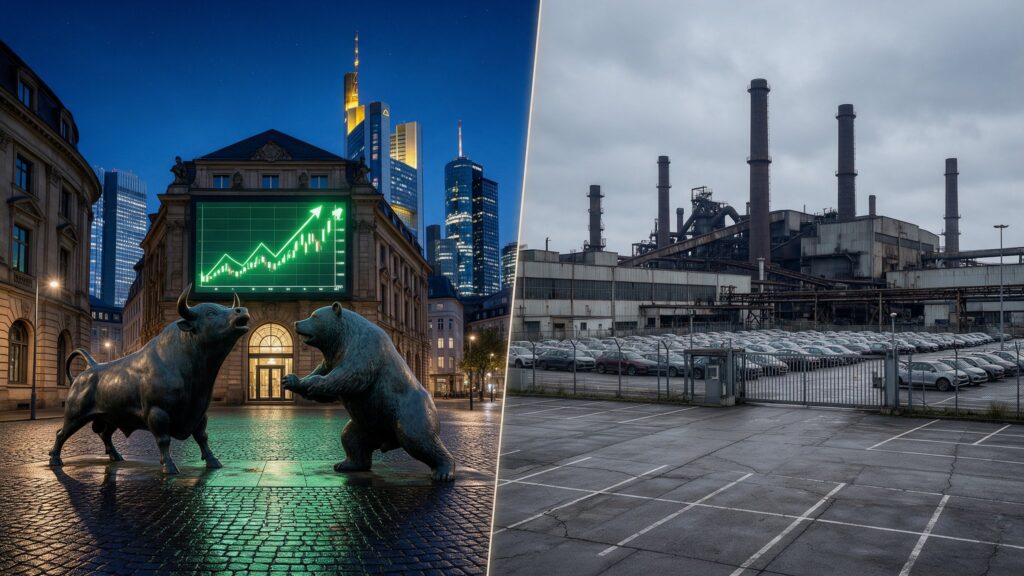
Market vs. Macro · Frankfurt / Wiesbaden · Data to 26 August 2026
In August the DAX touched 26,580, the highest level in its history. A month earlier, Germany’s unemployment count had stood at 2.99 million. Industrial output is back at roughly where it was in 2005. Tell someone in Berlin a few years ago that all of this would be true at the same time, and they would probably have assumed one of the numbers was a misprint.
Neither is. The two numbers are measuring different countries, and once you see that, most of the paradox goes away. Not all of it, though, and the parts that don’t go away are the more interesting ones.
The two facts
From the end of 2022 to 26 August 2026 the DAX rose about 89%. It closed 2025 up roughly 23%, its best year since 2019.
Over much the same stretch German real GDP went backwards. Destatis puts the three years at −0.9% for 2023, −0.5% for 2024 and +0.2% for 2025, a cumulative fall of about 1.2%. Manufacturing has been shrinking for three years running. Unemployment is at the 3 million mark.
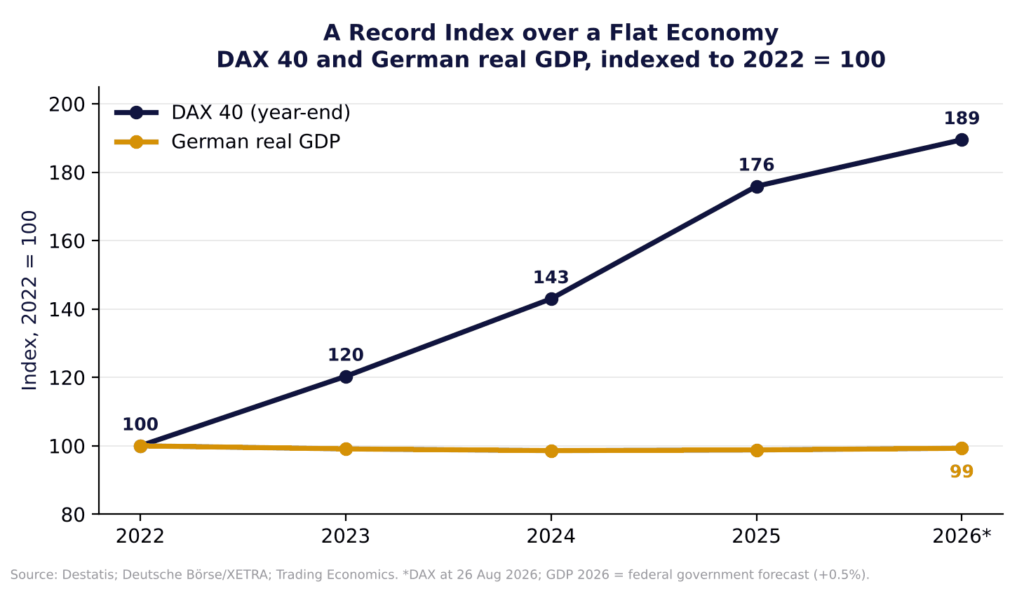
So how does an index nearly double while the economy underneath it goes nowhere? I count six reasons. None of them is a trick or an accounting fiddle, and any one of them would be enough on its own to stop the two lines moving together.
German by address, not by market
This is the big one. A Deutsche Bank analysis, cited by the index operator STOXX, found that only about 18% of DAX companies’ revenue is earned in Germany. The other 82% or so comes from abroad. Siemens sells factory automation in Texas and India. Airbus sells aircraft to Asian airlines. SAP sells software subscriptions just about everywhere, and Allianz and Munich Re insure risk around the world. For most of these companies, what the German consumer does this year barely registers in the profit and loss account.
STOXX’s own figures make the point more neatly than I can. The DAX correlates more closely with global GDP (0.41) than with German GDP (0.33). What you are looking at is a portfolio of multinationals that happen to be listed in Frankfurt. It was never a thermometer stuck into the German economy.
When the plant closes, the share price can rise
GDP counts what is produced inside Germany. A share price discounts what a company earns, wherever it earns it. Most people assume the two move together. Quite often they move in opposite directions.
Take a listed group that shuts a German plant, cuts a shift, or moves a production line to Hungary, Mexico or the US. German output falls and German jobs go with it. If the restructuring works, the company’s margins improve and its shares go up. German manufacturing output fell 1.3% in 2025, the third annual fall in a row, and much of the restructuring behind that was read by the market as good news. Good for the shareholder, bad for the statistician. Both readings were correct.
The index stopped looking like the economy some time ago
The DAX today is heaviest in industrial technology, insurance, enterprise software, power equipment, aerospace and semiconductors. The car industry, which for most people still simply is German industry, has shrunk to a small slice. No German carmaker is in the top fifteen, and none weighs more than about 2.4%.
That matters, because cars are where a lot of the pain is. German car exports to China fell to under €14bn in 2025, from nearly €30bn in 2022. You see that in the trade figures straight away. You hardly see it in the DAX at all.
Then there is the Mittelstand: the mid-sized, domestically rooted firms that employ most Germans and are carrying most of the current strain. Most of them aren’t in the DAX. Some sit in the MDAX, where industrials make up about 36%, or in the SDAX. Most aren’t listed anywhere. I don’t mean this as a criticism of the index. The DAX ranks the forty largest and most liquid listed companies, and it does that job perfectly well. It was just never meant to be a mirror of the German economy.
Germany keeps score differently
This one surprises people. The DAX figure you see in the news, 26,000 and change, is a performance index. It assumes every dividend is reinvested. The S&P 500, the CAC 40 and the FTSE 100 are normally quoted as price indices, which leave dividends out.
The difference is not cosmetic. The DAX price index, the Kursindex, stands at around 9,500, against roughly 26,000 for the performance index, a gap of about 173% built up over decades of compounding. In 2025 the price index rose 19.96% while the performance index rose about 23%. So far this year the figures are 4.57% and about 7.7%. Roughly three percentage points a year of “German shares did brilliantly” is dividend income that other countries’ headline numbers simply don’t count. It is real money for the shareholder. It just isn’t a like-for-like comparison, and it tells you nothing about the strength of the German economy.
The market is pricing 2029; GDP is reporting 2025
This is the timing explanation, and it accounts for most of the 2025 jump in particular. In March 2025 the Bundestag amended the constitution. It created a €500bn infrastructure special fund spread over twelve years, with €100bn going to the federal states and €100bn to the Climate and Transformation Fund, and it exempted defence spending above 1% of GDP from the debt brake altogether.
Markets repriced a decade of government orders for construction, grid, rail, IT and armaments more or less overnight. Rheinmetall, Renk and Hensoldt all more than doubled in 2025. The Bundesbank, meanwhile, expects the actual government demand to pick up sharply only from the second quarter of 2026. So the index rose in 2025 on cash flows expected between 2027 and 2035, while the GDP numbers everyone was quoting described 2024 and 2025. A share price is a forecast. GDP is a rear-view mirror. There is no reason they should agree.
Most of the buyers aren’t German either
An EY study of 2024 ownership found that foreign investors held 52.6% of DAX 40 share capital, against 33.1% held in Germany. US investors alone held 25.4%, up from 17.1% in 2010. Of roughly €54bn in dividends paid out for 2024, at least €26.9bn left the country.
So the person setting the price at the margin is not a German household reacting to conditions at home. It is a global fund manager weighing German shares against American ones. At the end of 2024 the DAX traded at about 13 times forward earnings while the US market looked expensive, and money rotated in. Prices went up for reasons that had nothing to do with the mood in Duisburg.
What’s actually inside the index
If you want the whole argument at a glance, look at the top of the index and at what these companies really sell.
| Company | What it actually sells | Weight |
|---|---|---|
| Siemens | Industrial automation & software, global | 11.8% |
| Allianz | Insurance & asset management, global | 9.4% |
| SAP | Enterprise software subscriptions, global | 9.1% |
| Siemens Energy | Grid & power equipment; record order book | 6.8% |
| Airbus | Commercial aircraft (French-headquartered) | 6.8% |
| Deutsche Telekom | Telecoms; majority of profit from T-Mobile US | 5.3% |
| Infineon | Semiconductors, global | 4.6% |
| Munich Re | Global reinsurance | 3.8% |
| Deutsche Bank | Investment & corporate banking | 3.5% |
| DHL Group | Global logistics | 3.1% |
| Rheinmetall | Defence; European rearmament | 3.0% |
| Deutsche Börse | Exchange & market data | 2.8% |
| Bayer | Pharma & crop science, global | 2.7% |
| BASF | Chemicals; the one genuinely energy-exposed heavyweight | 2.6% |
| E.ON | Regulated energy networks, largely domestic | 2.4% |
These fifteen make up about 84% of the index. Volkswagen, Mercedes-Benz, BMW and Porsche all fall below the cut. A word of caution on the numbers: the weights come from the Global X DAX Germany ETF as at 31 July 2026, so they are indicative rather than official. The index itself caps any single company at 10%, and weights move every day.
Where the neat story doesn’t hold
I would be overselling the argument if I stopped there. Three things cut against it.
The first is that the domestic mid-caps rose too. If the whole story were “only the multinationals went up”, the more domestic indices should have lagged badly. They didn’t. In 2025 the MDAX gained about 19% and the SDAX about 22%, against 22–23% for the DAX. That looks like a broad re-rating of German shares on the back of the fiscal package, not just a big-cap escape route. Over thirty years the MDAX has in fact beaten the DAX, with a total return of 1,088% since 1996 against 937%.
The second is that the defence trade has partly unwound already. On 21 August Rheinmetall stood at €1,155, down about 26% over the year and well short of its 52-week high of €2,008. Whatever is carrying the DAX to records in 2026, it isn’t rearmament any more. The recent gains have been led by AI-linked names such as Siemens Energy and Infineon, and by the banks.
The third is the currency. A common shortcut says the DAX rose because a weak euro flattered foreign earnings. In 2025 it was the other way round. The euro gained about 15% against the dollar, which shrinks foreign earnings once they are converted back into euros. The DAX rose anyway, which, if anything, makes the re-rating argument stronger.
So is the index unrepresentative of Germany?
Yes. But that is how it was designed, not a flaw. The DAX picks companies on market value and trading liquidity. That favours large, global, capital-light, largely foreign-owned firms, and it leaves out the domestic Mittelstand, which is where Germany’s economic trouble actually lives. Nobody built the DAX to stand in for the German economy.
So the claim that the DAX is one of Europe’s best performers is true as far as it goes. It is a statement about forty global companies and about a market putting a price on future German government spending. It is not a statement about German growth, industrial output, household purchasing power or the labour market, and all four of those are in poor shape.
If you want a market reading on the domestic economy, the MDAX and SDAX will tell you more, and so will the ifo business climate index, the PMI, insolvency counts and construction orders. And when you compare the DAX with the S&P 500 or the CAC 40, use the DAX Kursindex, or put all of them on a total-return basis. Otherwise you are handing Germany three free points a year.
Whether the economy eventually catches up with what the market is already pricing is a different question. Much depends on how much of that €500bn actually turns into orders, and how quickly. The Bundesbank’s December forecast had growth at 0.6% this year and 1.3% next, against potential growth it puts at just 0.4% a year, and the federal government has since cut its own forecast for 2026 to 0.5%. That is a recovery, but a modest one. The market is betting on rather more.
India presents the mirror image of this puzzle: an economy growing at close to 8% while the Nifty 50 falls. I take that up in a companion piece, which follows shortly.
Data notes and sources
A few cautions are worth carrying. The 18% domestic-revenue figure comes from a 2023 Deutsche Bank analysis and has not been updated since. ETF weights approximate the official index weights but are not the same thing. And German GDP figures are revised between statistical releases, so the 2022–25 path above may shift slightly in later vintages.
- Destatis, Gross domestic product up 0.2% in 2025: full-year GDP 2023 (−0.9%), 2024 (−0.5%), 2025 (+0.2%); manufacturing −1.3%, construction −3.6% in 2025.
- Destatis, Inflation rate at +2.8% in July 2026: core 2.4%, energy +8.3%, motor fuel +23.0%.
- Deutsche Bundesbank, Forecast for Germany, 19 December 2025: GDP 2026 +0.6%, 2027 +1.3%, 2028 +1.1%; potential output growth 0.4% a year.
- Euronews, Germany halves 2026 GDP forecast to 0.5%, 22 April 2026.
- Trading Economics, Germany Stock Market Index (DE40): level 26,382.50 and record high 26,580.40, August 2026; and DAX sees best yearly performance since 2019 (+23% in 2025).
- Deutsche Börse, Stocks in 2025: the third strong year in a row: DAX +22%, MDAX +19%, SDAX +22%; euro +15% against the dollar.
- STOXX, DAX tops 20,000 on strength of international-focused constituents: 18% domestic revenue; correlation 0.41 with global GDP against 0.33 with German GDP.
- Stock Analysis, Global X DAX Germany ETF holdings, 31 July 2026; and Rheinmetall AG, 21 August 2026.
- MS Aktuell, DAX-Rekord mit Kleingedrucktem, 4 August 2026: performance index against Kursindex, gap of about 173%; finanzen.net, DAX Kursindex Jahresperformance: +19.96% (2025), +4.57% (2026 to date).
- Noerr, Bundestag approves debt-brake exemption and special funds, March 2025: €500bn over 12 years; defence above 1% of GDP exempt.
- MarketScreener / EY, The majority of DAX companies are owned by foreign investors, 4 August 2025: 52.6% foreign, 25.4% US, 2024 data.
- GIS Reports, Germany’s long industrial decline, 7 August 2026: output at 2005 level; car exports to China under €14bn in 2025 against about €30bn in 2022.
- Trading Economics, Germany unemployment rate: 6.4%, 2.99 million, July 2026; STOXX, MDAX at 30, 19 January 2026; Siblis Research, DAX P/E ratio: forward P/E 12.99 at 31 December 2024.
- Year-end DAX levels used in the chart: 19,909.14 at end-2024 (stock3); 24,490.41 at end-2025 (Tagesspiegel); end-2022 and end-2023 levels from XETRA closes.
This is a personal analytical piece, not investment advice.