
15 October 2026 · Events
Trust as a Currency: Notes from the German Indian Innovation Summit
A day at the AXICA in Berlin, a friend's labour of love, and why the Indo-German economic story may finally be moving from potential to practice.

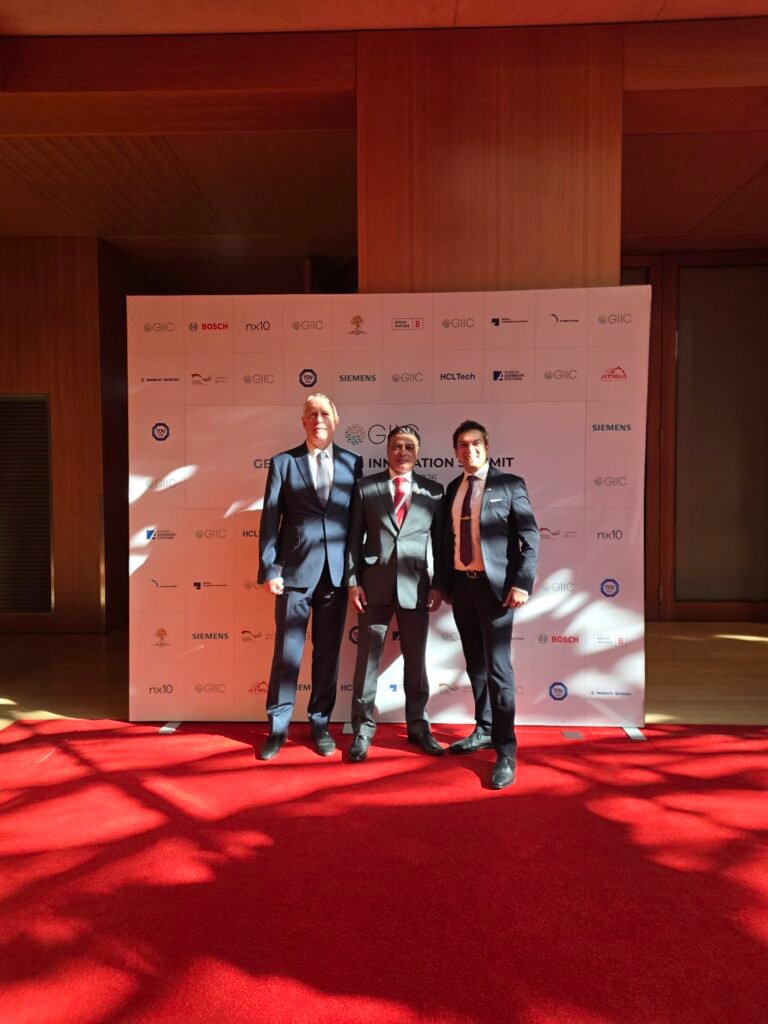
At the end of September I was back in Berlin for the German Indian Innovation Summit 2026, held on 29 September at the AXICA, a stone’s throw from the Brandenburger Tor. Anyone who has spent time in that part of the city knows the walk. Pariser Platz on one side, the embassies close by, tourists taking the same photograph people have been taking for thirty years. I have done that walk more times than I can count, usually on my way to a meeting where Germany and India agreed, very warmly, that the relationship had enormous potential.
This time the room felt different. I want to try and explain why, and also be honest about what a summit can and cannot do.
But first, a word about the man who made it happen.
A friend’s labour
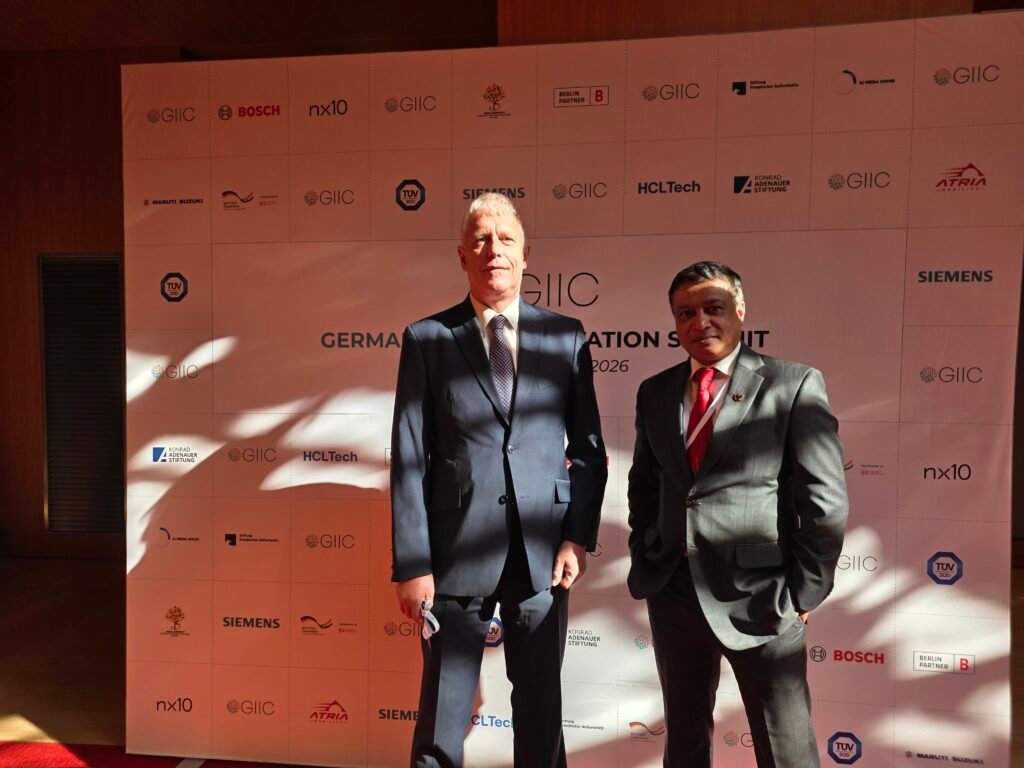
The summit is organised by the German Indian Innovation Corridor, GIIC, a Berlin-registered association that brings together companies, startups, investors, universities and public institutions from both countries. Jan Lachenmayer chairs its executive board. Upen Barwe, the Vice-Chair, is a close friend of mine, and I’ll declare that bias up front because it colours what I’m about to say.
Upen is the dynamic force behind all of this. Anybody who has tried to put three hundred senior people from two very different business cultures into one room, on one day, with an agenda that means something, knows how much stubborn effort sits behind a polished stage. Sponsors have to be persuaded, speakers chased, egos managed, and the Germans and the Indians have to be convinced that the other side is actually going to turn up. This was the second edition. The first, in 2025, drew a similar crowd, and a second year is always the harder one, because the novelty has gone and people come only if the first one was worth their time.
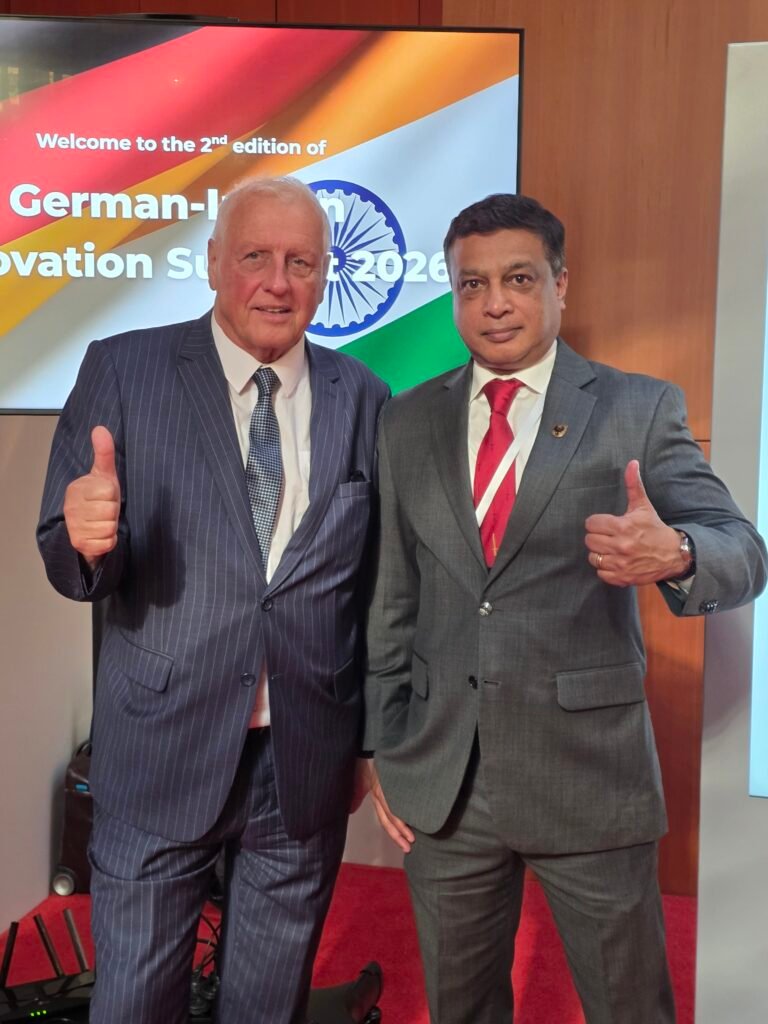
On stage, Upen said that trust is the common currency of an innovation corridor. Vertrauen ist die gemeinsame Währung. It’s the kind of line that could easily end up on a banner and mean nothing. Coming from him, I know it’s simply a description of how he works. I wish him every success with what comes next, and I suspect there is a good deal more coming.
What happened in the room
The theme this year was “AI for Industries”, with tracks on manufacturing, mobility, aerospace and defence, and health, plus sessions on geopolitical risk and the investment climate between the two countries. The speaker list ran from Harish Salve to Pankaj Vyas of Siemens Technology and Services, Sunil Kakkar of Maruti Suzuki and Norbert Jung of Bosch Connected Industry. German and Indian startups pitched in a deep-tech competition.
Speeches are speeches, though. What interested me more were the things that will still exist when the chairs are stacked away.
The India Desk Germany, run by GIIC with Berlin Partner für Wirtschaft und Technologie and NLND, is meant to give Indian startups and companies a landing point in Berlin and, through it, the wider European market. Dr. Stefan Franzke of Berlin Partner and GIIC’s Managing Director Siddharth Bhasin talked about its early cases. It’s a modest instrument. It is also exactly the sort of thing a small Indian firm needs and rarely finds: someone who will tell it which office to go to, which form to fill, and which German partner is serious.
A partnership with NASSCOM was announced by its Vice President Shivendra Singh together with Lachenmayer and Barwe. The idea is to connect German companies with India’s Global Capability Centre model, the arrangement under which SAP, Siemens and Bosch already run large IT and R&D operations in India. NASSCOM represents an industry it values at US$283 billion with more than 3,000 member firms. The big German names have long since worked out the GCC model for themselves. The interesting question is whether mid-sized German companies, the famous Mittelstand that makes up so much of the German economy and has far less appetite for adventure, can be persuaded to use it. If they can, that is where real numbers will come from.
And Elisabeth von Ritter of the Federal Ministry for Economic Cooperation and Development (BMZ) announced a GIZ GIIC Innovation Challenge on public urban mobility in Gurugram, with an emphasis on efficiency, inclusion, and the safety of women in public transport. Anyone who has used public transport in an Indian city after dark will understand why that last element matters. Funding and details are yet to be announced, so I’ll reserve judgement on scale.
The sceptic’s case, and what it leaves out
I’ll give the sceptic his due first, because he has a point.
For as long as I have been involved with Germany, the economic relationship with India has been described as under-performing. The numbers, even now, don’t make for a dramatic headline. Germany Trade & Invest, working from preliminary figures from the Federal Statistical Office, puts bilateral trade in 2025 at a record of roughly US$35 billion. A record, yes. But India still ranks only 21st among Germany’s export markets and 22nd among its sources of imports. German investment in India, depending on whose count you trust, sits somewhere between US$15 billion since 2000 and a stock of about €18 billion. For the most populous country in the world and the largest economy in Europe, that is not much. Summits in Berlin have been celebrating potential for twenty years and the potential has stayed largely potential.
All of that is true. What it misses is the direction of travel, and the shape of what is changing underneath.
Look at the composition of trade. In 2025, German exports to India barely moved, rising well under one per cent. German imports from India rose by about 12.5 per cent. Within that, imports of Indian machinery grew by nearly a quarter. India is no longer only a buyer of German machines. It is beginning to sell machines back to Germany, which would have sounded improbable when I first arrived in Berlin.
Then look at the scaffolding governments have put up over the past two years. Chancellor Merz made his first visit to India as Chancellor in January this year, starting in Ahmedabad with a delegation of German CEOs, and the two sides agreed, among other things, on a working group on semiconductors and a structured defence dialogue. The India-EU free trade agreement, after years of on-and-off negotiation, was concluded in January and is reportedly due to be signed on 16 December, with entry into force expected in early 2027. Berlin raised its annual cap on skilled-worker visas for Indians from 20,000 to 90,000 in 2024. And according to DAAD figures, there were 69,816 Indian students in Germany in the winter semester of 2025/26, the largest group of international students in the country by some distance.
Those students are worth pausing on. Seventy thousand young Indians learning German engineering, German regulation and, inevitably, German bureaucracy, is a bigger long-term asset than any single contract. Some will stay. Many will come home and spend the next thirty years as the most natural interlocutors between the two economies.
Fairness cuts both ways
Let me be fair to Germany first. The old reflexes that kept India at arm’s length, restrictive export licensing among them, are clearly loosening. On Project 75(I), the six-submarine programme with TKMS and Mazagon Dock, the German Ambassador to India, Jasper Wieck, said in September that Germany was ready to sign at any moment, as soon as the Indian side was. That’s quite a statement from a country that, not so long ago, was the one people in Delhi complained about for dragging its feet.
Which brings me to India. If the submarine contract is waiting, it is waiting in Delhi. Indian approvals can be slow, regulation can shift without much warning, and a foreign investor who has been burnt once by a retrospective change or a stalled clearance tells everyone at the next dinner in Stuttgart. German firms are cautious by temperament. They will not be argued out of that caution. They will only be shown, case by case, that the risk is manageable.
And on the German side, the problems are real too. Visa appointments, recognition of qualifications, the sheer weight of paperwork involved in hiring a foreign engineer or opening a small office. A 90,000 visa cap means little if the consulates cannot process applications in reasonable time.
What it portends
The GIIC’s own framing is that the two economies are complementary: German industry under pressure on costs and competitiveness, India growing quickly and expanding its digital and technological capacity. I agree, though I’d add something the brochures tend to leave out. Germany needs India more today than it did ten years ago. Its old model, cheap Russian energy, a vast Chinese market, and an American security guarantee taken for granted, has come apart in a remarkably short time. India is not a replacement for any of those things. But it is one of the few large partners on offer that is growing, democratic, and not looking to dominate German industry.
The FTA will help, but trade agreements open doors. They don’t walk anyone through them. That last part is done by people: the ones who make the introduction, explain why the Indian partner hasn’t replied for three weeks, or why the German one wants everything in writing. It is unglamorous work, and it is where organisations like GIIC earn their keep.
I have long believed that the Indo-German relationship runs on people. Berlin in September only reinforced that. The test for next year’s summit is a simple one. Not how many people came, or how many partnerships were announced from the stage, but whether some of those who met at the AXICA this year are doing business with each other by the time the next one comes round.
I’d bet on Upen to make sure a few of them are.
Sources used for facts above: GIIC (giic.co) on the summit programme and organisation; the GIIC press release of October 2026 as carried by startbase.de and pflumm.de; Germany Trade & Invest on 2025 German-Indian trade (preliminary Destatis data); NBM&CW (January 2026) on cumulative German FDI since 2000; reporting on Chancellor Merz’s January 2026 visit; The Hindu, via Vision IAS (September 2026), on the India-EU FTA signing date; The PIE News (August 2026) citing DAAD India on student numbers; The Week (September 2026) on Ambassador Wieck’s remarks on Project 75(I). Press-reported details are attributed as such in the text.